


For years, engineers have grappled with the challenge of Noise Reduction or blocking low-frequency noise. Traditional soundproofing methods, which rely on thick, heavy materials, are often too costly and bulky for modern applications. Now, researchers at the Swiss Federal Laboratories for Materials Science and Technology (Empa) have developed a groundbreaking solution: an ultra-thin, lightweight foam that effectively cancels out sound. This innovative material, made from mineral gypsum or cement foams, is poised to revolutionize the acoustics industry.

The Empa scientists use several porous layers for the new type of sound absorber with varrying thickness. Image: Empa

The new sound absorbers were tested in a driveway in Zurich. Image: Empa
Low-frequency sounds—the deep rumble of heavy traffic, the continuous hum of industrial machinery, or the thrum of an HVAC system—are notoriously difficult to manage. Their long wavelengths allow them to easily pass through conventional thin and light barriers, resonating and causing vibrations that travel through structures. The standard solution of building thicker, heavier walls is a costly and often cumbersome fix, particularly in retrofitting projects or in applications where weight is a critical factor, such as in vehicles or aircraft. This limitation has driven a global quest for smart, high-tech solutions that can tackle the problem without adding bulk.
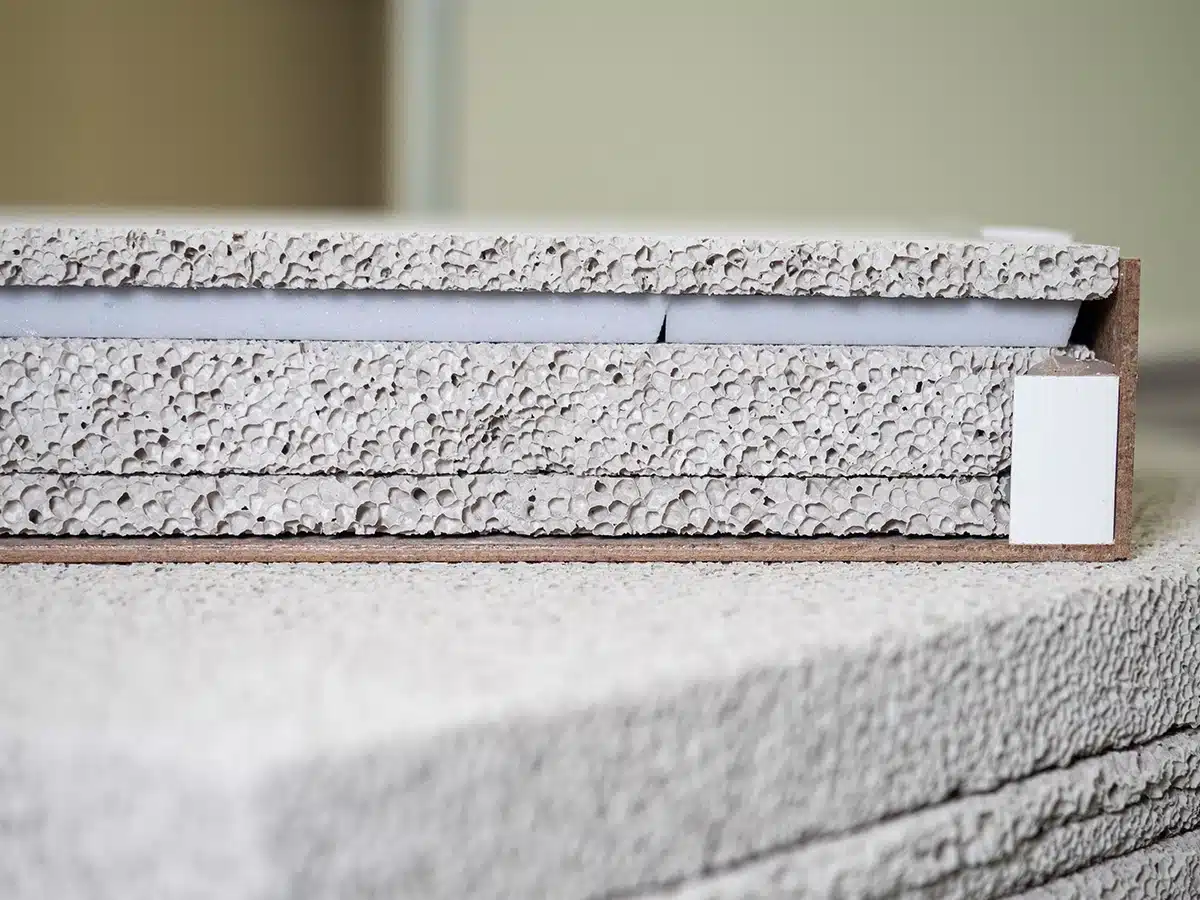
In these acoustic absorbers, noise is getting lost – literally. They are thus four times thinner than conventional materials. Image: Empa
The Empa breakthrough combines a unique, aerogel-like plastic foam with a smart, integrated component: a piezoelectric resonator. This innovative material is incredibly lightweight and possesses a porous structure, allowing it to interact with sound waves. Embedded within this foam is a thin, flexible plate made of a piezoelectric material. This material has a fascinating property: it generates an electric charge when subjected to mechanical stress or vibration, such as from an incoming sound wave. This dual-component system is the core of the new technology, offering a highly targeted and efficient way to combat noise.
The magic of this new material lies in a principle known as electromechanical feedback. When a sound wave strikes the foam, it causes the embedded piezoelectric resonator to vibrate. This vibration, in turn, generates a small electrical current. Here’s where the “smart” part comes in: a carefully tuned electronic circuit is connected to the resonator. This circuit is designed to create an electrical load that opposes the mechanical motion of the resonator. By generating a counteracting force, the circuit effectively dampens the vibration, converting the sound’s mechanical energy into electrical energy, which is then dissipated.
What makes this system a game-changer is its ability to be precisely tuned. The resonance frequency of the piezoelectric plate can be adjusted to specifically target and neutralize a dominant low-frequency noise. Unlike traditional broad-spectrum acoustic materials, which may absorb a wide range of frequencies inefficiently, this smart foam can be optimized to tackle a particular troublesome frequency with surgical precision. This makes it a highly effective and specialized solution for applications with specific noise profiles.
This innovation opens up a world of possibilities for the acoustics industry. Imagine soundproofing materials no thicker than a few millimeters, yet powerful enough to quiet the low-frequency drone of a busy city or the rumble of a factory. This technology could be seamlessly integrated into a wide range of applications:
This breakthrough underscores the ongoing evolution of acoustic technology. It’s a testament to the fact that effective noise control is no longer just about mass and thickness but about intelligent, high-tech design. For companies like Akinco, this represents a glimpse into the future—one where advanced material science provides innovative, elegant, and highly effective solutions to the age-old problem of noise pollution.
