

The soundtrack of productivity is often loud. The powerful roar of a generator, the rhythmic clang of a stamping press, the high-pitched whine of a turbine—these are the sounds of industry at work. But this immense acoustic energy, if left unchecked, can transform from a sign of progress into a significant liability. Uncontrolled industrial noise is a serious hazard that poses risks to employee health, regulatory compliance, and community relations.
A strategic and engineered approach to soundproofing for industrial sites is no longer an optional extra; it is a fundamental requirement for responsible and sustainable operation. This comprehensive guide will explore why industrial soundproofing is critical, the core principles behind effective noise control, and the practical solutions that can bring peace and safety to the loudest of environments.
Before diving into the solutions, it’s crucial to understand the high stakes involved. Taming industrial noise is about much more than just quietening things down.
Authorities around the world, including local municipalities in India, have strict regulations regarding noise pollution. These fall into two main categories:
This is the most important reason for noise control. Prolonged exposure to high noise levels can cause permanent Noise-Induced Hearing Loss (NIHL) and tinnitus (ringing in the ears). Beyond hearing damage, excessive noise is linked to increased stress, fatigue, cardiovascular problems, and a higher risk of workplace accidents due to an inability to hear warning signals or communicate effectively. Soundproofing for industrial sites is a direct investment in the long-term health of your workforce.
Noise complaints from neighbouring communities can quickly escalate into a public relations crisis, leading to legal challenges and damaging a company’s reputation. Proactive noise management demonstrates corporate responsibility and fosters a positive relationship with the community, ensuring a stable operating environment for years to come.
Effective soundproofing isn’t about just one product; it’s a systematic strategy built on three core principles. The most effective approach, known as the source-path-receiver model, involves tackling noise at every stage.
Here are the most effective and commonly used engineering solutions for controlling noise along its path.
For large, stationary noise sources like generators, compressors, large pumps, and stamping presses, the acoustic enclosure is the ultimate solution. This is a custom-built, soundproof room constructed around the equipment. It features a heavy-duty steel outer shell and a thick internal lining of fire-retardant, sound-absorbing insulation (like rock wool). Crucially, these enclosures are designed with acoustically treated ventilation systems (using attenuators or acoustic louvers) to allow for airflow without letting the noise escape.
For outdoor noise sources spread over a large area, such as cooling towers, transformers, or entire processing plants, an acoustic barrier is ideal. These tall, dense walls are strategically placed between the noise source and the receiver (e.g., a residential area). They work by blocking the direct line of sight for sound waves. For a barrier to be effective, it must be long and high enough to prevent sound from easily travelling around or over it, and it must be made of a dense, solid material.
Noise doesn’t just travel through the air; it travels through the veins of a facility. HVAC ducts and industrial pipes can radiate significant noise. Acoustic lagging, a composite material typically made of a dense vinyl barrier and a layer of acoustic foam, is wrapped around ducts and pipes. It effectively blocks noise from breaking out and contains the sound within the system.
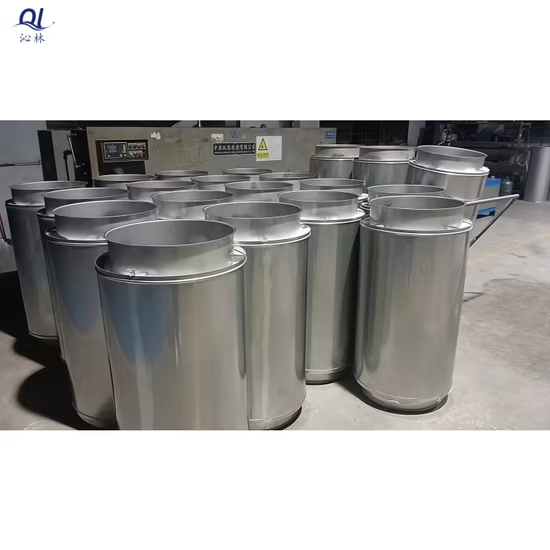
Anywhere air or gas is forced through an opening, noise is created. Industrial exhausts, large fan intakes, and ventilation systems are major culprits. Sound attenuators, or silencers, are like a muffler for these systems. They contain a series of internal baffles lined with acoustic media that absorb the sound energy as air passes through, significantly quieting the output.
When a wall opening is needed for constant, natural airflow (e.g., in a generator or mechanical room), an acoustic louver is the solution. These louvers have specially shaped blades filled with sound-absorbing material. They allow air to pass freely through a winding path while trapping and absorbing the noise.
A crucial, often-missed aspect of soundproofing for industrial sites is controlling vibration. A large machine bolted directly to the floor will transmit its vibrational energy throughout the entire building structure, which then radiates as noise in completely different areas. Placing machinery on specialized vibration isolators, such as heavy-duty spring mounts or neoprene pads, decouples it from the structure and stops this “structure-borne” noise at the source.
A successful soundproofing project follows a clear, methodical process:
Industrial noise is a complex but entirely solvable problem. By viewing soundproofing for industrial sites not as an expense but as a vital investment, companies can protect their most valuable assets: their people and their license to operate. A strategic, well-engineered approach to noise control leads to a safer workplace, a healthier environment, and a stronger, more sustainable business.