


In a city as dynamic and ambitious as Dubai, the sound of progress is everywhere. But inside our world-class offices, luxurious hotels, and comfortable homes, we expect a sanctuary of peace. The unsung hero responsible for this quiet is a powerful, often unseen component of your building’s ventilation system: HVAC Sound Attenuator.
From the constant hum of a massive air conditioning (HVAC) unit cooling a skyscraper to the whir of fans in a data center, noise generated by essential equipment is a constant challenge. This noise travels effortlessly through the veins of a building, its ductwork emerging in boardrooms, bedrooms, and hospital wards.
This guide is designed to be the most comprehensive resource on sound attenuators available. We will delve deep into what they are, the science of how they work, the different types, and how to select the right one, with a special focus on the unique challenges and applications here in Dubai.
A Sound Attenuator, also known as a duct silencer or sound trap, is an engineered acoustic device designed to be inserted into ductwork to reduce the transmission of noise.
Its core purpose is simple but critical: to significantly decrease noise levels while having minimal impact on the airflow.
Think of it like this: your HVAC duct is a highway for air. But this highway also carries the unwanted noise from the fan. A sound attenuator is like a specialized tunnel on that highway, lined with a material that acts like a sponge for sound. As the air and noise pass through, the air continues on its journey relatively unaffected, but a huge portion of the sound energy gets trapped and absorbed.
It is not simply insulation wrapped around a duct. It’s a precisely calculated device with internal baffles and acoustic media designed for maximum noise reduction at specific frequencies.

The Science Behind the Silence: How Do Attenuators Actually Work?
To understand how an attenuator works, you first need to understand that sound is energy. A sound attenuator’s job is to dissipate this energy. It achieves this primarily through one key principle:
The most critical component inside a sound attenuator is the acoustic-grade fill material, typically high-density, fire-resistant fiberglass or mineral wool. This material is highly porous.
The acoustic media is protected from the airstream by a perforated metal sheet, which allows sound to pass through to be absorbed but prevents the fibers from eroding into the airflow.
The internal ‘splitters’ or baffles inside a rectangular attenuator also help by creating multiple pathways. Sound waves are reflected back and forth between these absorbent surfaces, giving them more opportunities to be absorbed before they can exit the attenuator.
HVAC Sound Attenuators are not a one-size-fits-all product. They come in various shapes and designs, each suited for a specific application.
 This is the industry workhorse and the most common type you’ll find. They consist of a rectangular casing with multiple parallel baffles inside.
Circular Attenuators
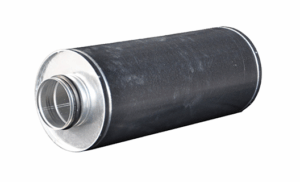 Designed for use in circular ductwork, these can be straight or have a built-in elbow.

These are a special type designed to solve a very specific problem: speech privacy. In modern offices, a common air duct often connects two adjacent rooms via the ceiling space (plenum). This creates a direct path for conversation to travel from one office to another.
To choose the right sound attenuator, you must understand how its performance is measured. This data is found on the manufacturer’s technical specification sheet.
This is the single most important metric. Insertion Loss is the amount of noise (in decibels, dB) that the attenuator removes from the system. It is measured across different frequency bands (typically 8 octave bands, from 63 Hz to 8000 Hz). A higher number means better performance.
Example: If an attenuator has an insertion loss of 20 dB at 250 Hz, it means it reduces the noise at that specific frequency by 20 decibels, a massive, clearly audible difference.
This measures how much resistance the attenuator adds to the airflow, measured in Pascals (Pa). Every component in a duct system creates some resistance, forcing the fan to work harder.
This is the noise created by the air itself as it tumbles through the attenuator. It’s important that the “silencer” doesn’t become a new source of noise. This is rated with a Noise Criteria (NC) or Noise Rating (NR) value. A lower number is better.
In a climate like Dubai’s, powerful HVAC systems are a necessity, not a luxury. This makes effective noise management absolutely critical across various sectors.
Getting the maximum benefit from a sound attenuator depends on choosing the right one and installing it correctly.
In the pursuit of architectural excellence and unparalleled user comfort that defines Dubai, controlling the acoustic environment is not a luxury. It’s a fundamental requirement. The humble Sound Attenuator is a critical piece of engineering that makes this possible.
It’s an investment in productivity in the workplace, recovery in hospitals, luxury in hotels, and peace in our homes. By understanding the science behind them and the importance of proper selection, we can effectively engineer silence, ensuring that our indoor environments are as serene as they are spectacular.
Don’t let HVAC noise compromise your project. Contact the acoustic engineering experts at Akinco today for a consultation on selecting and implementing the perfect sound attenuator solution for your needs in Dubai. Akinco also have small small dusct Sound Attenuator
