


The world of acoustics and soundproofing is undergoing a quiet revolution, powered by the incredible capabilities of Artificial Intelligence (AI). What was once a field heavily reliant on physical materials, empirical testing, and the seasoned judgment of experts is rapidly transforming into a data-driven science. AI is no longer a futuristic concept but a practical reality, enabling professionals to design, test, and implement noise control solutions with unprecedented precision, efficiency, and intelligence. By leveraging machine learning, predictive analytics, and real-time data processing, AI is expanding the scope of what’s possible, from creating smarter building designs to developing dynamic materials that respond to their environment. 
One of the most transformative applications of Artificial Intelligence in acoustics is its ability to move from reactive problem-solving to proactive, predictive design. Traditionally, acoustic design involved complex simulations and physical prototypes, a time-consuming and often costly process. AI changes this by enabling architects and engineers to model and predict sound behavior with remarkable accuracy before a single brick is laid.
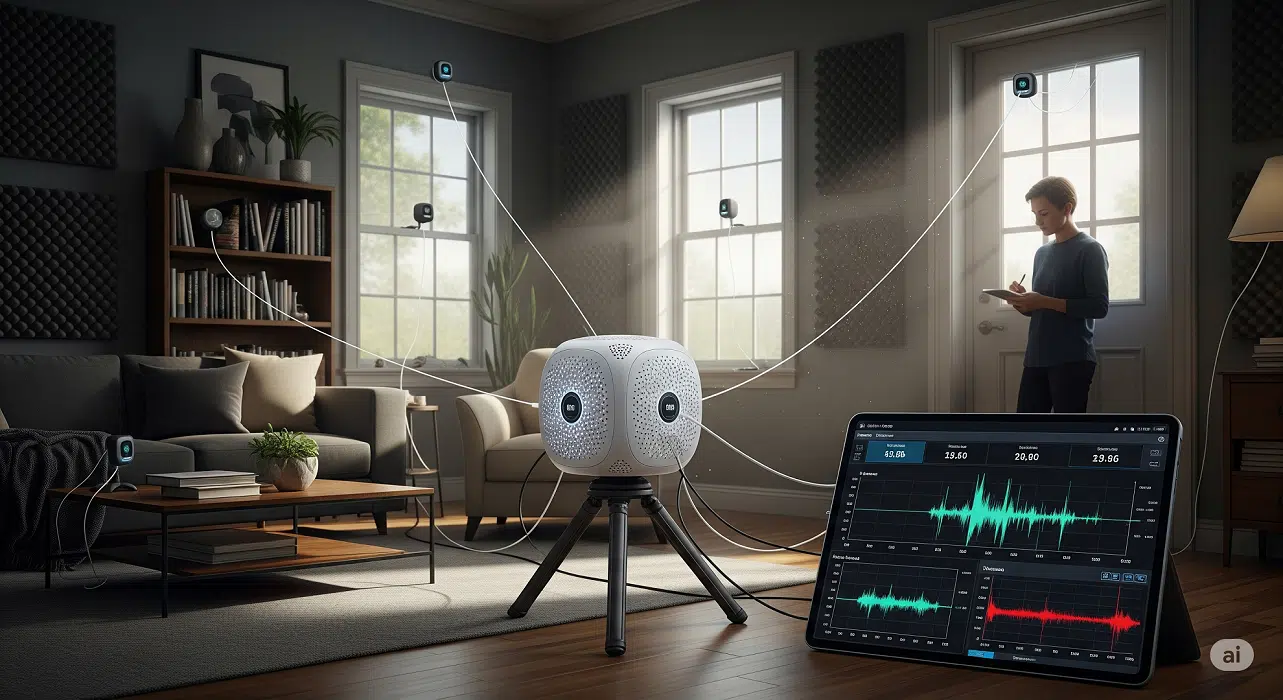
The painstaking process of Sound-Testing and Noise-Testing is being fundamentally reinvented by AI. Where engineers once spent hours manually collecting and analyzing data, AI-powered tools can now automate the process, providing deeper and more immediate insights. This is particularly critical for sound and Vibration Testing, where the data is often complex and multi-faceted. AI tools for assessment work by analyzing raw acoustic data—from microphones, accelerometers, and other sensors—to instantly identify the source, frequency, and intensity of noise and vibration. This capability is invaluable for troubleshooting. For example, a maintenance crew using an AI-powered tool to assess a factory floor could quickly pinpoint which specific machine is generating excessive noise or vibration, even amidst the cacophony of a busy workspace. The AI can isolate the problematic frequency and recommend a targeted solution, such as a specific type of vibration control pad or an acoustic enclosure.
The development of AI has given rise to a new generation of smart tools designed to simplify and enhance sound and Vibration Testing. These tools, while still evolving, represent the future of the industry:
The scope of AI extends beyond analysis and design to the materials themselves. AI is the brain behind the next generation of “smart” soundproofing.

The scope of Artificial Intelligence in acoustics is not limited to individual buildings or products. Artificial Intelligence’s ability to process and analyze large datasets is providing valuable insights into noise pollution on a city-wide scale. By analyzing data from a network of acoustic sensors, AI can create detailed noise maps that identify the primary sources of urban noise pollution, from construction sites to traffic corridors. This information is a critical tool for urban planners, allowing them to make data-driven decisions about zoning, traffic management, and the placement of green spaces to mitigate noise and improve public health. In conclusion, AI is fundamentally changing the field of acoustics and soundproofing. It is moving us from a reactive, material-centric approach to a proactive, data-centric one. From predictive design and automated Sound-Testing to the development of intelligent materials and advanced vibration control systems, Artificial Intelligence is empowering professionals to create quieter, more comfortable, and healthier environments in ways that were once unimaginable. The future of soundproofing is intelligent, and it is powered by AI.
