

Walk into any building supplies store or browse any online marketplace in the UAE right now, and you will find dozens of products claiming to “soundproof” your space, “eliminate echo,” or “block all noise.” Most of them are overpriced, underperforming, or outright misleading. This guide cuts through the noise — literally — and gives you the honest, technical truth about what works, what wastes your money, and how to make the right decision for your specific space.
The single biggest mistake buyers in the UAE make is confusing sound absorption with soundproofing. These are not the same thing, and no acoustic panel manufacturer will spell this out clearly for you, because it would hurt sales.
Sound absorption reduces echo and reverberation inside a room. Acoustic panels achieve this by converting sound energy into a tiny amount of heat as sound waves pass through or into the panel material. The result is a room that sounds cleaner, clearer, and less echoic.
Soundproofing prevents sound from travelling between spaces, through walls, floors, doors, and ceilings. This requires mass, decoupling, and structural isolation. No panel stuck to a wall will stop your neighbour from hearing your TV.
Once you understand this distinction, you can make buying decisions based on what you actually need, not what the product description implies.
When evaluating any acoustic product, look for these four measurable properties:
NRC is a single number between 0 and 1 that represents a material’s average sound absorption across four frequencies (250 Hz, 500 Hz, 1000 Hz, 2000 Hz). An NRC of 0 means the material reflects all sound. An NRC of 1 means it absorbs all sound.
A quality acoustic panel should have an NRC of 0.80 or higher. Be deeply suspicious of any product that does not publish its NRC value; that omission is intentional.
Thin panels (25mm or less) only absorb high-frequency sounds. They do almost nothing for mid-range or bass frequencies. In most real-world applications, offices, home cinemas, studios, the problematic frequencies are in the mid and low range. You need panels that are at least 50mm thick, and for studios or rooms with significant bass issues, 100mm panels or corner bass traps are necessary.
The most effective core materials for acoustic panels are:
Rigid fibreglass (e.g., Owens Corning 703/705): High NRC, excellent across a broad frequency range, industry standard for professional applications.
Rockwool / mineral wool: Similar performance to fibreglass, slightly heavier, fire-resistant, and widely available in the UAE.
Open-cell acoustic foam (melamine foam): Effective for mid-to-high frequencies, lighter and easier to handle, good for studios and broadcast rooms.
Polyester fibre / PET panels: Increasingly popular, made from recycled materials, safe for children’s spaces, good mid-frequency performance.
Avoid: Closed-cell foam (like packing foam or many cheap “studio foam” products), egg-crate foam, and decorative panels with no published NRC data. These offer minimal real-world acoustic benefit.
A panel’s outer finish affects both its acoustic performance and its longevity. Fabric-wrapped panels must use acoustically transparent fabric, a fabric so tightly woven that it blocks sound rather than letting it through, defeating the entire purpose. Ask suppliers to confirm the fabric’s acoustic transparency rating. In the UAE’s climate, you also want fabric that resists humidity and does not off-gas in high temperatures.
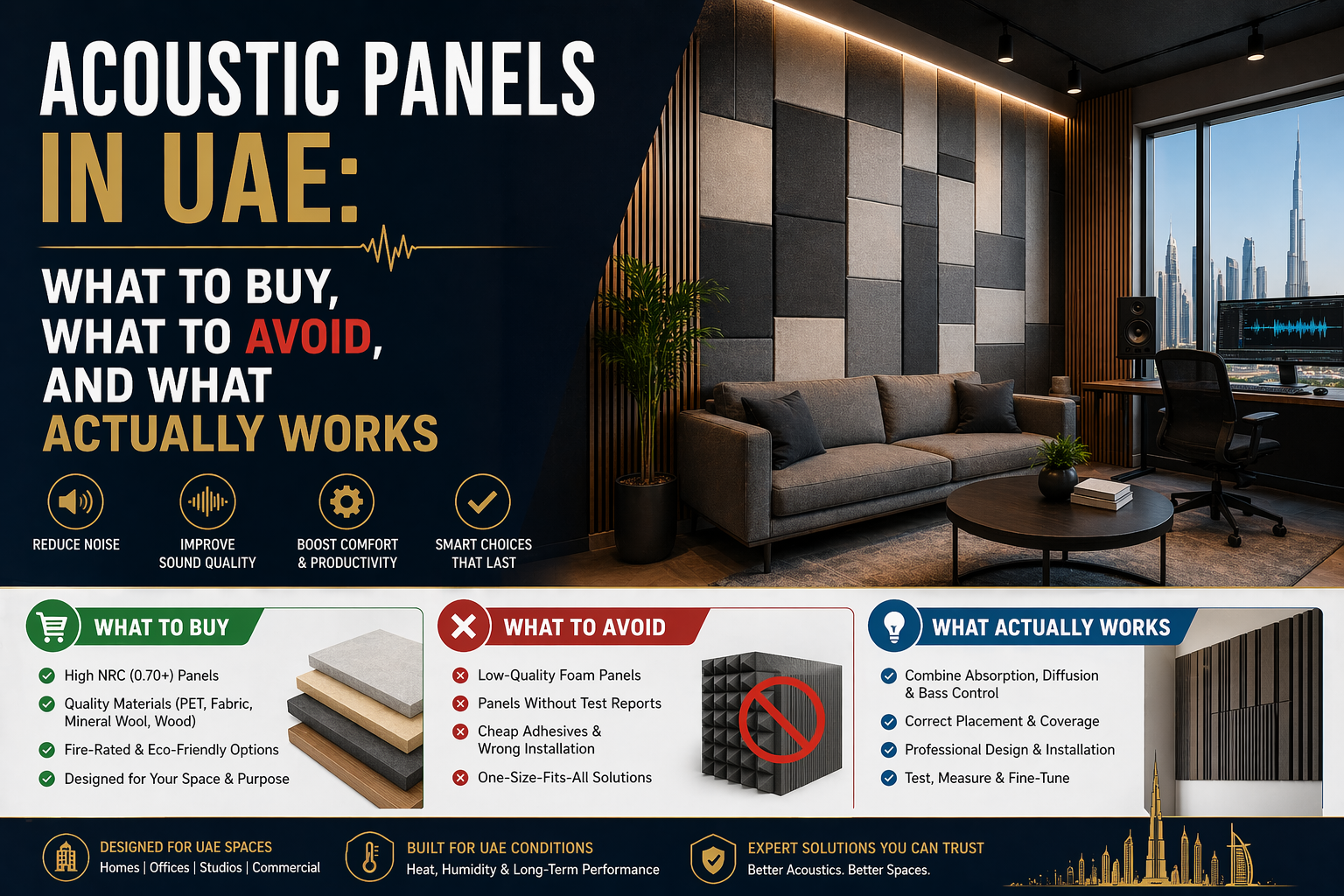
You see these everywhere, cheap foam panels with a wavy or pyramid surface, often sold in multipacks on Amazon. ae, Noon, or in bulk on Careem Now. They are virtually useless for real acoustic treatment. Their NRC values are typically below 0.50, they degrade quickly in Dubai’s humidity, and they are a fire hazard if not treated with flame retardant.
If a thin panel claims to soundproof your room, walk away. As established above, panels absorb, they do not block. Any product claiming to be “soundproof” with a panel alone is either misusing terminology or deliberately misleading buyers.
A common mistake is buying too few panels and placing them on just one wall. Acoustic treatment only works when you achieve a sufficient coverage ratio — the proportion of a room’s total surface area covered by absorptive material. For a typical room, you need to treat at least 25–30% of the total surface area to hear a meaningful difference. An acoustic consultant can calculate the exact coverage needed for your room dimensions and intended use.
Many buyers treat one wall and wonder why the room still sounds bad. Flutter echo, the rapid, repeating reflection between two parallel walls, requires treatment on both opposing surfaces. Low-frequency modal buildup in corners requires bass traps, not standard flat panels. Buying without a room analysis first often means spending money in the wrong places.
Are you trying to reduce echo in a meeting room? Improve speech clarity in a call centre? Create a broadcast-quality podcast studio? Treat a home cinema? Each use case has different target frequencies, different NRC requirements, and different coverage ratios. Start with a defined goal.
A basic acoustic measurement using free tools like Room EQ Wizard (REW) and a calibrated measurement microphone gives you a reverberation time (RT60) graph. This tells you exactly which frequencies your room struggles with and how much treatment you need. Without this data, you are guessing, and guessing is expensive.
Insist on products with NRC values tested by independent laboratories (ISO 354 or ASTM C423 standards). Reputable suppliers in the UAE will provide these. If a supplier cannot produce test data, that is a red flag.
Strategic placement of fewer, high-quality panels outperforms scattering many cheap panels randomly. First reflection points (the spots on walls and ceilings where sound bounces before reaching your ears), corners (for bass), and rear walls (for diffusion) are the highest-priority locations.
For commercial spaces, clinics, hospitality environments, or any space with significant structural constraints, engage an acoustic consultant before purchasing. The cost of a consultation is invariably less than the cost of buying the wrong products and having to start over.
The UAE market is flooded with acoustic products, and not all of them deserve your money. The difference between a good outcome and a wasted budget comes down to understanding what you need, specifying products with real data, and placing them correctly.
For spaces across Dubai and the wider UAE, acoustic panels UAE solutions that carry independently verified performance data are the only ones worth considering. Akinco Dubai takes a data-led, specification-first approach to every acoustic project — ensuring that what you buy actually solves the problem you have.
Q1: How many acoustic panels do I need for a standard meeting room in Dubai? A standard meeting room of approximately 20–30 square metres typically requires 30–40% surface coverage to achieve an RT60 of under 0.5 seconds, which is the accepted standard for speech clarity in conference rooms. In practical terms, this means treating ceiling clouds, two opposing walls, and potentially the rear wall. An acoustic consultant can calculate exact quantities based on your room’s dimensions and surface materials.
Q2: Are acoustic panels from international brands available in the UAE, or should I buy locally? Both options are viable. International brands like Armstrong, Knauf, Saint-Gobain, and Vicoustic distribute through UAE dealers. Local manufacturers and fabricators also produce quality fabric-wrapped panels using imported rockwool or fibreglass cores. The key is not where the panel is made — it is whether it carries verified NRC data for the specific product, not just the material category.
Q3: Do acoustic panels work in outdoor or semi-outdoor spaces like Dubai cafes with open facades? Standard acoustic panels are designed for enclosed interior spaces. In semi-outdoor or open environments, the acoustic energy dissipates too freely for panels to have a meaningful effect. However, specially designed outdoor diffusers and absorbers exist for pergola-style or covered outdoor dining areas. These require weather-resistant materials and a different design approach.
Q4: Can I install acoustic panels myself, or do I need a professional installer? For simple residential applications — a home studio, podcast room, or home office — DIY installation is entirely feasible with the right adhesive, brackets, or French cleat systems. For commercial installations, especially where panels are ceiling-mounted or integrated into architectural elements, professional installation is strongly recommended for both safety and performance reasons.
Q5: How long do acoustic panels last in Dubai’s climate? Quality fabric-wrapped mineral wool or fibreglass panels, properly sealed and finished, last 15–20 years or more in conditioned interiors. The main risks to longevity in Dubai’s climate are humidity ingress (if the building envelope is compromised) and UV exposure (if panels are placed near uncovered windows). Acoustic foam degrades faster — typically 5–10 years — and should be replaced when it begins to crumble or off-gas.
