

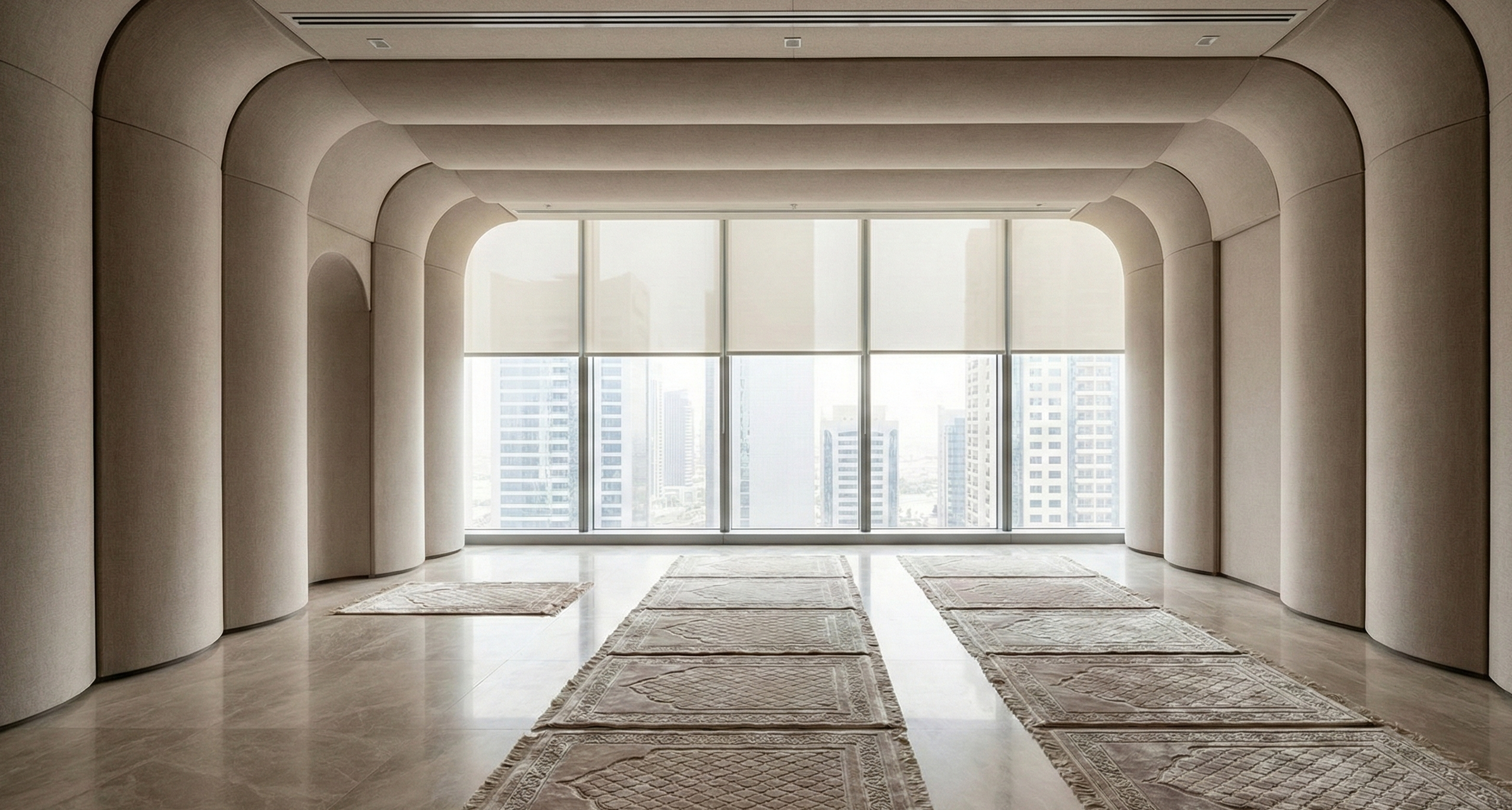
Prayer rooms represent essential facilities in UAE commercial buildings, required by law and valued by employees. These sacred spaces deserve acoustic design creating peaceful environments conducive to focused worship and meditation.
Poor acoustics compromise prayer rooms’ fundamental purpose. Echo disrupts concentration during individual prayer. Sound leaks from adjacent offices and corridors disturb peaceful reflection. HVAC noise and building systems intrude on moments meant for spiritual connection.
Proper acoustic treatment transforms prayer rooms into true sanctuaries within busy commercial environments. Here’s how to design prayer room acoustics that honor their religious and cultural significance while meeting practical performance requirements.
Prayer rooms serve different acoustic requirements than typical office spaces. These rooms need deep silence supporting meditation and focused prayer. External noise must remain completely inaudible, maintaining the separation between secular workplace and sacred spiritual practice.
Internal acoustics should support clear recitation without excessive reverberation. Speech intelligibility matters during group prayers and Quranic recitation, requiring controlled reflection times that preserve clarity.
Privacy holds paramount importance. Conversations and prayers inside must remain confidential, protected from unintentional eavesdropping by passing colleagues. Sound isolation works both directions, keeping prayer room activities private while blocking workplace noise.
Soundproofing solutions create the isolation prayer rooms require from surrounding office activities. Effective isolation prevents workplace noise from entering while keeping prayers and conversations private.
Construct prayer room walls with sound-rated assemblies including insulation and multiple layers of gypsum board. Standard office partitions provide inadequate isolation. Proper construction achieves STC ratings of 50 or higher, blocking normal office conversation and activities.
Install solid-core doors with acoustic seals and automatic drop seals. Standard hollow office doors leak sound freely, compromising expensive wall isolation. Acoustic door hardware creates airtight seals when doors close, preventing sound leakage.
Position prayer rooms away from loud mechanical equipment, elevator shafts, and high-traffic corridors whenever possible. Thoughtful location reduces isolation challenges and creates naturally quieter environments.
Address flanking paths where sound travels around barriers through ceiling plenums, ductwork, and structural connections. Extend sound-rated walls to structural deck above suspended ceilings. Wrap ductwork penetrations with acoustic insulation.
Acoustic panels control internal reflections, managing reverberation without over-deadening the space. Prayer rooms need balanced acoustics supporting both individual meditation and group recitation.
Install acoustic panels on walls at seated and standing height. Cover 30 to 40 percent of wall surface with absorption material. Distribute panels evenly rather than concentrating them on one wall for uniform acoustic control.
Choose neutral colors and simple designs respecting prayer rooms’ sacred purpose. Avoid busy patterns or imagery that might distract from spiritual focus. Earth tones and subtle textures create calming environments appropriate for meditation.
Fabric-wrapped panels offer the best combination of performance and aesthetics. Specify fabrics tested for flammability meeting commercial building codes. Premium fabrics withstand regular cleaning and maintain appearance over years of use.
Prayer room ceilings require acoustic treatment controlling vertical reflections and preventing sound transmission through ceiling plenums to adjacent spaces.
Acoustic ceiling tiles provide comprehensive absorption while contributing to sound isolation between floors. Specify tiles with high CAC ratings blocking sound transmission through plenum spaces.
Suspended acoustic clouds supplement standard ceiling tiles in rooms with particularly challenging acoustics or aesthetic requirements. Clouds in geometric patterns add visual interest while enhancing sound absorption.
Avoid hard gypsum board ceilings without acoustic treatment. Painted drywall reflects sound aggressively, creating echo and harsh acoustics inappropriate for contemplative spaces.
Carpet provides ideal prayer room flooring, combining acoustic absorption with the soft surface required for prostration during prayer. Dense carpet with quality padding absorbs impact noise and reflections.
Choose commercial-grade carpet withstanding regular use and cleaning. Prayer rooms experience constant foot traffic during prayer times, requiring durable materials maintaining appearance.
Specify neutral solid colors or subtle patterns avoiding visual distraction. Carpet contributes significantly to overall acoustic comfort while fulfilling practical requirements.
Mechanical system noise represents a common prayer room acoustic problem. Loud air conditioning, vibrating ductwork, and rattling diffusers destroy the peaceful atmosphere these spaces require.
Specify low-velocity HVAC design reducing air noise through ducts and diffusers. High-velocity systems create whooshing sounds audible during quiet prayer.
Install acoustically lined ductwork near prayer rooms. Fibrous duct lining absorbs sound traveling through supply and return air paths, preventing mechanical room noise from reaching occupied spaces.
Choose quiet diffusers designed for noise-sensitive applications. Sound ratings published by manufacturers allow comparison during specification. Premium diffusers cost slightly more but provide significantly quieter operation.
Locate thermostats outside prayer rooms preventing compressor cycling noise from disturbing occupants. External controls maintain comfort without introducing mechanical sounds.
Fluorescent ballasts and LED drivers generate audible hum disturbing quiet prayer rooms. Specify quality lighting components with low acoustic emission.
Position transformers and ballasts outside prayer rooms when possible. Remote mounting eliminates electrical hum from the worship space while maintaining required illumination levels.
Use indirect and ambient lighting reducing the number of fixtures and associated noise sources. Fewer high-quality fixtures outperform numerous budget units generating acoustic interference.
Provide sound-absorbing storage for shoes, bags, and personal items. Wooden cubbies or fabric storage absorb sound while organizing belongings left outside the prayer area.
Upholstered benches or cushioned seating areas for waiting absorb sound and provide comfort. Avoid hard plastic or metal seating that reflects sound and creates noise during use..
Prayer rooms serve diverse populations with varying practices and expectations. Acoustic design should accommodate different prayer styles while respecting Islamic principles and local customs.
Consult with employee resource groups or religious advisors during design. Their input ensures acoustic solutions support actual worship practices rather than assumptions.
Maintain separate men’s and women’s prayer facilities when required, ensuring both receive equal acoustic treatment and quality. Acoustics should never differ between gender-designated spaces.
Akinco UAE understands the cultural significance and acoustic requirements of prayer rooms in UAE commercial facilities. Their experience with local building codes, religious requirements, and acoustic best practices ensures appropriate solutions.
Professional acoustic assessment identifies specific challenges in your facility before design begins. Custom acoustic panels and soundproofing solutions integrate with architectural plans and interior finishes. Installation teams respect the sacred nature of these spaces during construction.
Prayer rooms represent employers’ commitment to employee wellbeing and cultural values. Proper acoustic design honors this commitment through peaceful, quiet spaces supporting spiritual practice. Partner with Akinco UAE to create prayer room acoustics worthy of their important purpose. Your employees will appreciate the thoughtful acoustic environment enabling focused worship.
