
Have you ever tried taking an important Zoom call only to hear someone laughing loudly in the background? Or maybe you’ve struggled to focus because the co-working space around you is buzzing with conversations. In today’s world of hybrid work, this happens more often than we’d like to admit.
That’s exactly why Hybrid Work Acoustics has become such a big deal especially in a rapidly growing business hub like Dubai. Whether you’re a CEO, a freelancer, a startup team, or even a homeowner trying to set up a small home office, the need for quiet, focused zones is now non-negotiable.
In this blog, we’ll explore how to create effective quiet zones in Dubai co-working spaces using smart acoustic design, real-world examples, cost-friendly tips, and modern solutions you can implement right away.
As hybrid work becomes the new normal, people split time between the office, home, and co-working spaces. That means environments must be designed to support:
Focus-intensive tasks
Virtual meetings
Group collaboration
Private conversations
Deep work
The problem? Many co-working spaces prioritize aesthetics over sound control. Sure, an open layout looks great on Instagram but when five people start talking at once, productivity disappears.
Poor acoustics leads to:
Distractions
Miscommunication
Stress and fatigue
Lower productivity
Poor meeting quality
In Dubai, where businesses operate at high speed and multicultural teams rely heavily on digital communication, creating quiet zones isn’t optional; it’s essential.
Quiet zones are dedicated areas designed to reduce noise and improve concentration. Think of them as micro-environments within a larger workspace where sound is controlled, hushed, and predictable.
A well-designed quiet zone does three things:
Absorbs sound (stops echoes and loud reflections)
Blocks noise (prevents outside sound from entering)
Controls personal noise (reduces disruption from inside)
For Dubai’s fast-paced co-working culture, especially in places like Business Bay, JLT, Dubai Marina, and Downtown, these spaces are lifesavers.
If your space feels “echoey,” it’s probably because sound waves are bouncing around unchecked.
How to fix it:
Add acoustic panels on the walls
Use acoustic ceiling tiles
Install high-density foam or fabric panels
Add thick carpets or rugs
Real example:
A small co-working corner in JLT added 16 fabric acoustic panels and saw a 60% reduction in reverberation, resulting in quieter calls and fewer complaints.
This is where materials like acoustic doors, partitions, and insulation shine.
Solutions include:
Acoustic doors with rubber seals
Double-glazed partitions
High-STC (Sound Transmission Class) insulation
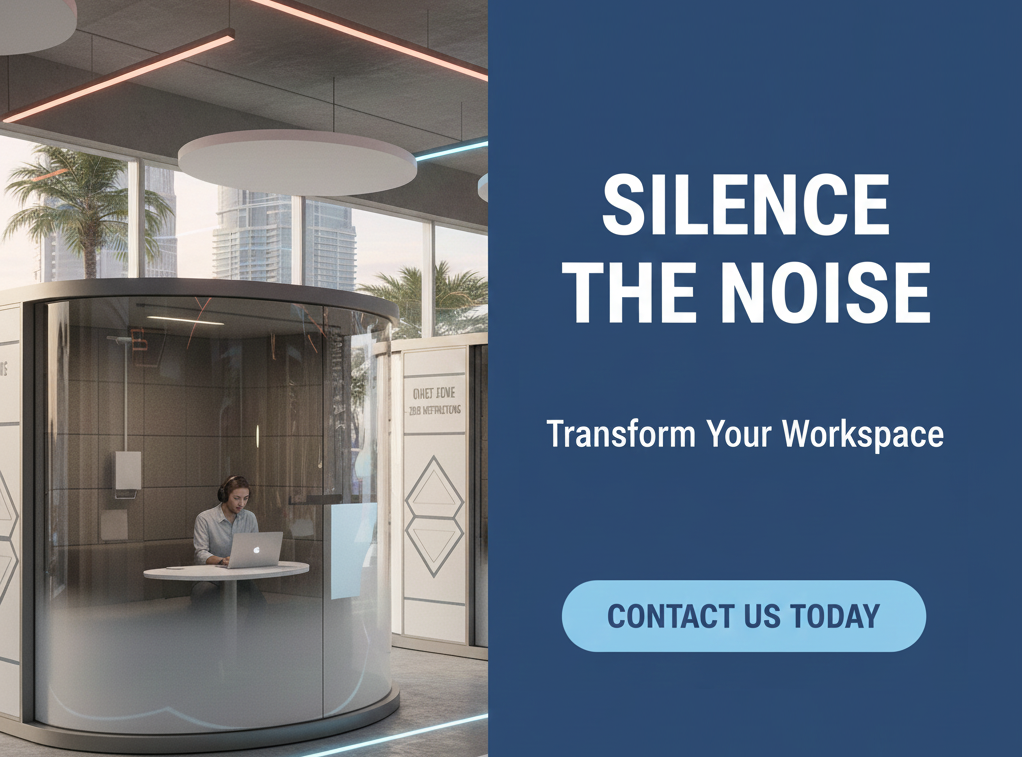
Fully sealed meeting pods
These are extremely useful for quiet phone booths, podcast rooms, and focus cabins.
Dubai co-working spaces often mix open layouts with private enclaves. Proper zoning ensures noise-producing areas don’t clash with quiet spaces.
Tips for smart zoning:
Place meeting rooms far from focus areas
Keep social lounges away from work tables
Add semi-enclosed booths along the perimeter
Use plants, bookshelves, and acoustic dividers as buffers
A simple shift in floor plan can reduce noise disruptions by up to 30%.
Believe it or not, furniture plays a big role in sound control.
Consider:
High-back sofas
Upholstered chairs
Acoustic desk dividers
Phone booths
Soft seating lounges
Soft, plush furniture absorbs sound naturally, making it perfect for quiet zones.
Today, hybrid work requires more than just quiet spaces; it needs smart tech.
Helpful additions:
Noise-canceling microphones
Sound masking systems
“Do Not Disturb” indicator lights
Headphone charging stations
Acoustic-friendly meeting pods
Sound masking, in particular, is a game changer. It adds a subtle background noise that reduces disruptions and increases speech privacy.
Before installing anything, check:
Where noise is coming from
Echo levels
Conversation spillover
Meeting room leakage
Traffic noise from outside
Many Dubai acoustic professionals offer basic audits to identify weak spots.
Instead of one generic silent room, create multiple targeted spaces:
Phone booths for calls
Focus pods for deep work
Silent rooms for strict quiet
Semi-quiet zones for mild conversations
Library-style zones for long working hours
This ensures everyone finds the right environment to match their work style.
Some of the most effective materials include:
Acoustic fabric panels
High-density foam panels
Acoustic doors
Underlay insulation
Ceiling baffles
Desk dividers
Carpets and rugs
Soft wall coverings
They don’t just control noise, they also add warmth, texture, and a modern aesthetic.
Dubai’s design standards are high. Luckily, acoustic materials now come in:
Stylish patterns
Vibrant colors
Sleek textures
Modern shapes
Quiet zones can look just as stunning as the rest of the space, sometimes even better.
Even the best acoustic design fails if people don’t follow the rules.
Common guidelines:
Keep calls under 10 minutes
Use headphones
Silence notifications
Respect quiet hours
Avoid dragging chairs
A simple digital screen or wall sign can reinforce these reminders.
Since your audience includes homeowners too, here are simple tips:
Use a thick carpet or rug
Add curtains and fabric wall art
Install 2–4 small acoustic panels
Use a solid-core or acoustic door
Add a bookshelf filled with books
Position your desk against a soft surface
Even a small 2x2m home office can become 40–50% quieter with minor upgrades.
Quiet zones don’t have to be expensive. Here’s a rough idea:
| Solution | Cost Range |
|---|---|
| Acoustic Panels | AED 80–250 per sq. ft |
| Acoustic Doors | AED 1,500–4,000 |
| Meeting Pods | AED 10,000–40,000 |
| Sound Masking | AED 5–15 per sq. ft |
| Wall Insulation | AED 25–80 per sq. ft |
Business owners and corporate clients often mix premium materials with budget-friendly options for optimal results.
It refers to designing spaces that support quiet, distraction-free work for people who split time between home, office, and co-working environments.
They help reduce distractions, improve focus, and support high-quality virtual meetings.
Acoustic panels, ceiling baffles, rugs, curtains, foam panels, and acoustic doors.
Not necessarily. Even small upgrades like rugs or a few acoustic panels can significantly reduce noise.
Absolutely. Homeowners can soundproof a home by using carpets, paneling, curtains, bookshelves, and acoustic doors for effective sound control.